
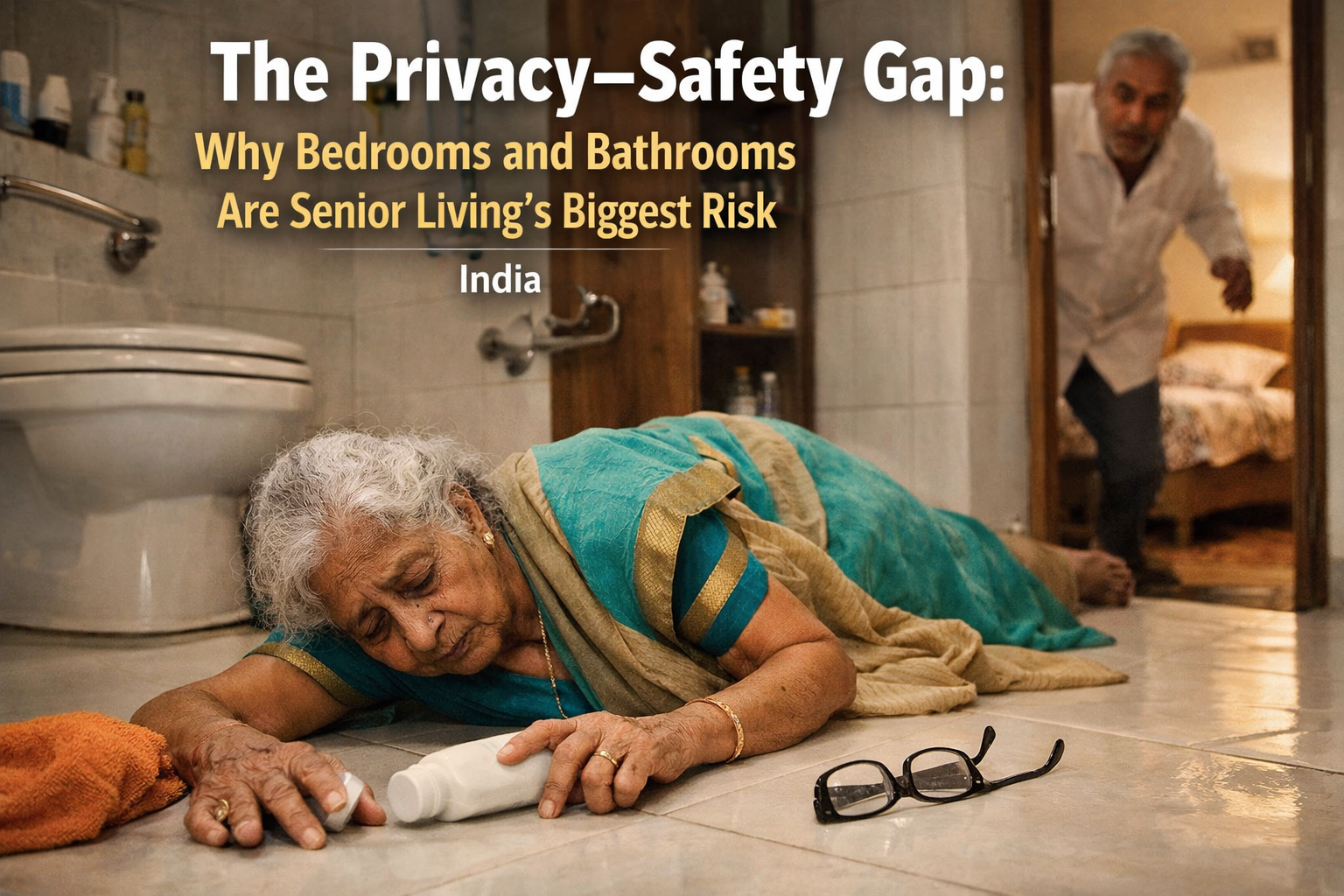
In senior living communities, safety planning often focuses on common areas—corridors, dining halls, and activity spaces. These spaces are visible, social, and easier to supervise.
However, many of the most serious safety incidents do not happen in shared areas. They occur in bedrooms and bathrooms—the very places where residents spend the most time and where direct supervision is, by design, limited.
These private spaces create invisible risk zones. Not because of neglect, but because of a difficult and long-standing trade-off: how do you protect residents without compromising their dignity and privacy?
1. The Core Conflict: Risk and Privacy in the Same Space
Bedrooms and bathrooms are uniquely challenging because they combine three high-stakes realities:
- Higher risk: Falls and incidents often occur during bed transfers or night-time bathroom visits
- High expectation of privacy: Continuous observation or cameras are not appropriate
- Limited caregiver presence: Especially during night shifts, caregivers cannot be everywhere at once
This creates situations where an incident can go unnoticed for longer than anyone would want. Closing this gap requires moving beyond simply watching residents to understanding movement and risk in a more respectful way.
2. The Night-Time Movement Gap
At night, private spaces become considerably higher risk. Residents may:
- Get out of bed in low light
- Walk without mobility aids
- Experience disorientation or confusion
- Move when staffing levels are reduced
Traditional care models rely heavily on physical rounds, but these come with hidden limitations:
- Sleep disruption: Even brief checks can wake residents and increase disorientation
- The gap between checks: An incident may occur minutes after a round and remain unnoticed
- Loss of homelike feel: Repeated night-time entries can make private rooms feel monitored rather than personal
While rounds remain important, they are not sufficient on their own to manage private-space risk.
3. The Difference Between Watching and Knowing
For many years, safety in senior living was closely tied to visibility. If staff could see more, it was assumed safety would improve. This led to cameras, frequent checks, and visual supervision.
Privacy-first intelligent monitoring takes a different approach.
Instead of using a lens, it interprets movement and activity patterns. It does not capture faces, bodies, identities, or moments of personal privacy.
What the system processes are abstract dots and motion patterns—not images of people.
In simple terms, it focuses on what is happening, not who is being watched.
Watching vs Understanding (Conceptual Difference)
- Surveillance-based approaches see a person in a private moment
- Privacy-first intelligent monitoring interprets anonymous movement patterns
This distinction allows caregivers to be informed when something is wrong—without visually observing residents in their most private spaces.
4. Closing the Gap with Xealei™
Xealei™ Device Care Intelligence is a smart platform supported by motion sensing and vital monitoring devices, designed to enhance resident safety, quality of care, operational efficiency, and compliance across senior living facilities.
Xealei™ applies the “dots, not humans” approach to help senior living teams turn invisible risk zones into safer, more supportive environments—without cameras or wearables.
Bed Exit Awareness: Supporting Timely Assistance
Many incidents are identified only after they occur. Xealei™ detects movement patterns associated with bed exits—one of the highest-risk moments for falls—so caregivers can be alerted earlier and provide timely assistance during these vulnerable moments.
Bathroom Safety Without a Lens
Bathrooms are among the highest-risk spaces in any senior living community. Risk in bathrooms is not limited to a single type of incident—it typically appears in two distinct ways, both of which are difficult to address with traditional systems.
A. Falls Inside the Bathroom
Falls frequently occur inside bathrooms due to:
- Wet or slippery surfaces
- Confined movement space
- Transitions between standing, sitting, and turning
- Residents being alone at the time of the incident
Most traditional safety systems struggle here:
- Cameras are not appropriate in bathrooms
- Wearables may not be worn consistently
- Manual checks are infrequent
Xealei™ can identify sudden movement patterns consistent with a fall inside the bathroom, even in darkness or humid conditions such as steam from showers. Caregivers are alerted promptly—without any visual monitoring—allowing for faster response in one of the most sensitive spaces.
B. Prolonged Bathroom Stay
A prolonged stay in the bathroom is a separate and equally critical risk signal. It may indicate:
- A fall that was not immediately obvious
- Dizziness or weakness
- Difficulty standing up or moving
- Medical distress
Because bathrooms are private spaces, prolonged stays often go unnoticed until the next physical check.
Xealei™ monitors duration and movement patterns within the bathroom and alerts caregivers when a resident remains inside longer than expected—enabling timely intervention without intrusion or surveillance.
No Resident Burden
Because the intelligence is built into the environment:
- Residents do not need to wear devices
- No buttons need to be pressed
- No behaviour changes are required
Protection continues even if a resident is asleep, disoriented, or unable to call for help.
5. Why Addressing These Gaps Matters
When safety gaps in bedrooms and bathrooms remain unaddressed:
- Response times may increase
- Resident confidence may decline
- Families may feel uncertain about care oversight
- Care teams face additional pressure during already demanding shifts
Addressing these gaps is essential for improving outcomes while preserving the personal nature of senior living environments.
6. Conclusion: Making Private Spaces Safer Without Making Them Public
Bedrooms and bathrooms represent the most sensitive balance in senior living—high risk and high privacy.
By adopting privacy-first intelligent monitoring, communities no longer need to choose between safety and dignity. They can support residents during their most vulnerable moments—at night, in private spaces, and without intrusion—while ensuring caregivers receive the right information at the right time.
Xealei™ helps senior living communities make private spaces safer, without making them public.